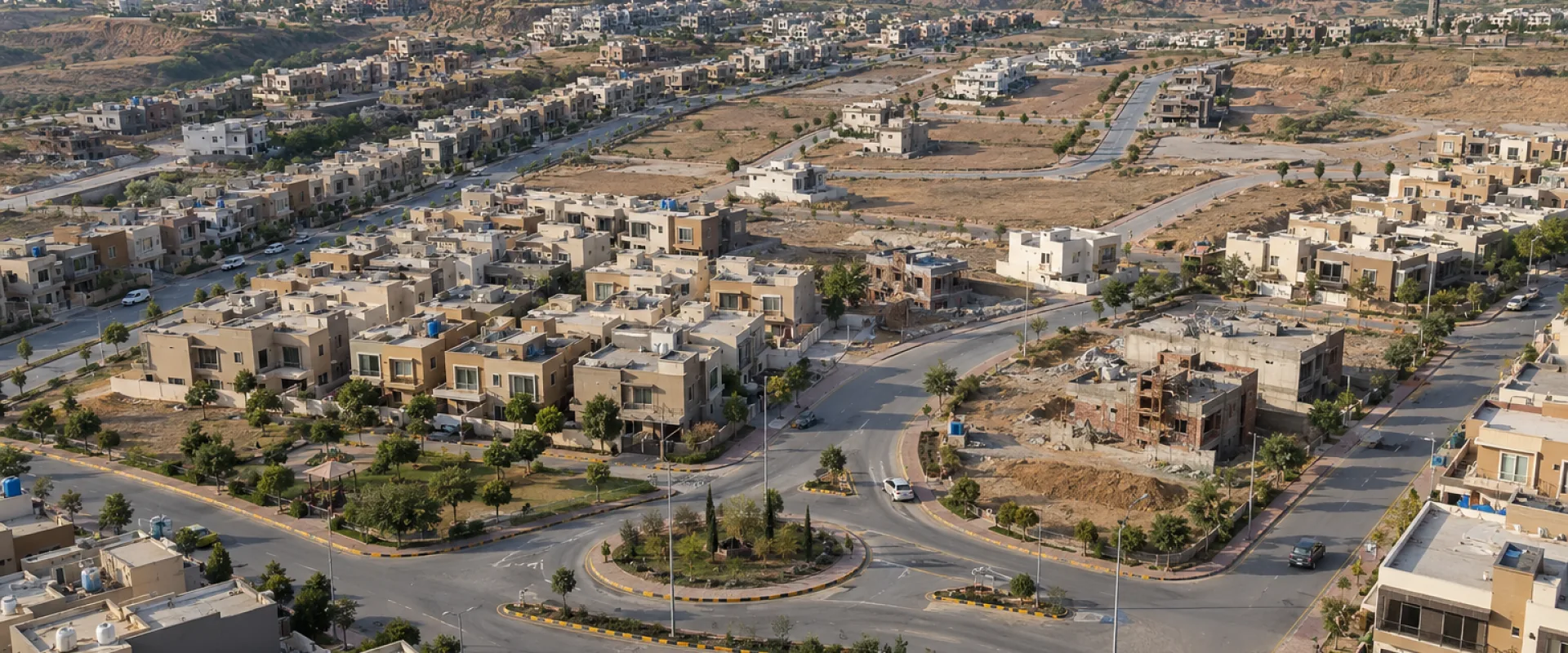
Mera Ghar Mera Aashiana 2026: Loans for Islamabad Buyers

The Mera Ghar Mera Aashiana scheme 2026, now officially called the Wazir-e-Azam Apna Ghar Program "Ghar Ho Tu Apna", gives first-time buyers a home loan of up to Rs10 million at a fixed 5% markup for the first 10 years, with tenure of up to 20 years. You can use it to buy a house of up to 10 marla or a flat of up to 1,500 sq ft, to build on a plot you own, or to buy a plot and build on it. You apply online through the government portal or directly at a participating bank, and you put in at least 10% of the property value yourself.
This guide covers the current terms, who qualifies, what Rs10 million can realistically buy in Islamabad and Rawalpindi, how to apply, and how the subsidised loan compares with a normal KIBOR-based home loan, with the monthly instalments worked out.
Key takeaways
- Maximum loan: Rs10 million (raised from Rs3.5 million by the ECC on 27 February 2026).
- Markup: a uniform 5% for the borrower for the first 10 years. The old 8% tier was removed. Banks earn one-year KIBOR plus 3% and the government pays the difference.
- Tenure: up to 20 years. After year 10 the subsidy ends and pricing is reported to move to market rates.
- Property size: houses up to 10 marla (2,720 sq ft) or flats up to 1,500 sq ft.
- Equity: the loan-to-value ratio is 90:10, so you pay at least 10% yourself, plus transfer costs.
- Who qualifies: first-time owners with a CNIC. Since June 2026, NICOP and POC holders also qualify. Bank employees are generally excluded.
- Costs: no processing fee and no prepayment penalty, and banks are told to decide on a complete application within 15 working days.
Mera Ghar Mera Aashiana scheme 2026: terms after the February ECC change
The State Bank of Pakistan (SBP) launched Mera Ghar Mera Aashiana (MGMA) in September 2025 as a markup-subsidy and risk-sharing scheme. The original version had two tiers. Tier 1 covered loans up to Rs2 million at 5%, and Tier 2 covered Rs2 million to Rs3.5 million at 8%. Eligible units were capped at 5 marla, or flats up to 1,360 sq ft, as Dawn reported at launch.
Those limits were too low for most buyers in Islamabad, where Rs3.5 million barely covers a down payment in many societies. Take-up was slow. By late February 2026, banks had received 10,594 applications seeking Rs32.288 billion but had disbursed only 344 loans worth Rs810 million, according to Profit's report on the ECC decision.
On 27 February 2026 the Economic Coordination Committee (ECC) approved a revised package. The federal cabinet then ratified it, and the SBP notified the revised framework in March 2026. In late March, a Ministry of Housing and Works notification renamed the scheme "Wazir-e-Azam Apna Ghar Program – Ghar Ho Tu Apna". Prime Minister Shehbaz Sharif formally launched it under that name on 30 April 2026. Most people and many bank staff still call it Mera Ghar Mera Aashiana, so both names refer to the same product.
Old vs new terms at a glance
| Feature | Original MGMA (Sept 2025) | Current Apna Ghar terms (2026) |
|---|---|---|
| Maximum loan | Rs3.5 million | Rs10 million |
| Borrower markup | 5% (up to Rs2m), 8% (Rs2m to Rs3.5m) | Uniform 5% fixed for first 10 years |
| Bank pricing | 1-year KIBOR + 3% | 1-year KIBOR + 3% (difference subsidised) |
| Maximum tenure | 20 years | 20 years |
| Subsidy period | First 10 years | First 10 years |
| House size limit | 5 marla | 10 marla (2,720 sq ft) |
| Flat size limit | 1,360 sq ft | 1,500 sq ft |
| Loan-to-value | 90:10 | 90:10 (reported) |
| Processing fee / prepayment penalty | None | None |
| Credit decision target | Not specified | 15 working days from complete application |
| Overseas Pakistanis | Not covered | NICOP and POC holders eligible (from June 2026) |
Terms as checked on 19 November 2026, based on SBP notifications as reported by Profit, Dawn and Business Recorder. Confirm the latest circular on sbp.org.pk and with your bank before you apply.
Two details matter for planning. First, the ECC said loans already disbursed at 8% would be adjusted to 5%. Second, the government has budgeted Rs71 billion in subsidies for FY2026-27 and is targeting 150,000 homes financed by June 2027. The longer-term goal is 500,000 units over four years. The subsidy is paid against actual disbursements within annual budget limits, so terms for new applicants could change in a future budget. Loans already booked should keep their agreed terms, but read your offer letter carefully.
Mera Ghar Mera Aashiana eligibility: who can apply
The core rule is simple: the scheme is for first-time homeowners. Based on the SBP framework and its later clarifications, you must meet the following conditions.
- Pakistani identity: a valid CNIC for residents. Since June 2026, a NICOP or Pakistan Origin Card (POC) also qualifies.
- No existing housing unit: you must not already own a house or flat in your name. If you own a plot, you can still use the "construct on own plot" option, but owning a built house disqualifies you.
- Repayment capacity: the bank runs its normal income and credit checks. Reports at the April 2026 launch mentioned a debt burden ratio cap of 65%. In practice, banks look at your total monthly debt payments against your net income.
- Clean credit history: by July 2026, roughly 13,000 of about 107,000 applications had been rejected. The main reasons cited were past loan defaults, poor credit histories, or applicants withdrawing (ProPakistani). Check your eCIB record before you apply.
- Not a bank employee: an SBP circular letter of 14 September 2026 clarified that employees of commercial banks, DFIs and microfinance banks cannot take subsidised finance under the programme. They have access to staff housing loans instead. A narrow exception has been reported for contractual staff below officer grade who are not eligible for staff housing finance.
You do not need to be salaried. The programme allows freelancers and informal-sector workers to show repayment capacity through bank statements, utility bills or even mobile top-up records. In practice, a self-employed applicant with six to twelve months of regular deposits in a bank account will find approval much easier than someone who works in cash.
No official age limit for the scheme itself appears in the reporting we reviewed. Banks normally apply their own age rules, typically requiring the loan to end before a set age at maturity. If you are over 45, ask the bank how this affects your maximum tenure.
Can a husband and wife apply together?
Banks generally allow a co-applicant, usually a spouse or close family member, to combine incomes. The ownership rule applies to the applicants, so check that neither of you already owns a house or flat. Confirm the treatment of joint applications with your bank, because practice varies.
What qualifies: house, flat, or plot plus construction
The scheme finances four uses, according to SBP and government statements.
- Buying a ready house of up to 10 marla (2,720 sq ft).
- Buying a flat or apartment of up to 1,500 sq ft.
- Building a house on a plot you already own.
- Buying a plot and then building on it (plot plus construction as one financing).
Note what it does not do. It is not a loan to buy a bare plot as an investment, and it is not a loan to buy a file. A "file" in Islamabad and Rawalpindi societies is an allocation right without a specific, demarcated, possession-ready plot. Banks need a property they can value and take a mortgage on, which means clear title, an approved layout and usually a registered sale deed or allotment with possession. If the society lacks CDA or RDA approval, expect the bank's legal team to reject it.
This is the single biggest practical filter for Islamabad buyers. Before you pay token money on anything you plan to finance, read our guide on how to verify a plot or file before you pay token money and check the society against our list of illegal and approved housing societies in Islamabad and Rawalpindi.
Apartment loan Islamabad: what to check on a flat
Flats are often the easiest route under the scheme because the 1,500 sq ft cap covers most one- and two-bedroom units. Still, banks usually want:
- A completed or near-completed building, not an off-plan booking on instalments.
- An approved building plan and a completion or occupancy certificate where applicable. For CDA-regulated buildings, check with CDA. For Bahria and DHA, check the society's own approval chain.
- A sub-lease or transfer deed that can be mortgaged in the bank's favour.
- Covered area on the documents that matches the 1,500 sq ft limit. Developers sometimes quote "gross" area including common space, so check the figure on paper.
Construction loans
For construction, banks typically release money in stages against progress (foundation, grey structure, finishing) after a site inspection at each stage. You will need an approved building plan from CDA, RDA or the society. Our house construction cost guide for Islamabad 2026 helps you estimate whether Rs10 million covers a grey structure plus finishing on a 5 or 7 marla plot.
What Rs10 million can buy in Islamabad and Rawalpindi
The scheme sets a size cap, not a price cap, in the reporting we reviewed. Because the loan-to-value ratio is 90:10, a full Rs10 million loan matches a property valued at roughly Rs11.1 million. You can buy something more expensive if you bring the extra equity, but the loan stays at Rs10 million. Confirm with your bank how it treats properties priced well above the loan.
The table below gives indicative asking-price ranges collected from agent, developer and listing sources in mid to late 2026. Prices vary widely by block, possession status and construction quality. Treat them as a starting point, not a valuation.
| Area | Property type | Indicative asking range (2026) | Fit with a Rs10m loan |
|---|---|---|---|
| Gulberg Greens / Gulberg Residencia | 1-bed flat | Roughly Rs43 lakh to Rs1.38 crore depending on project; premium towers much higher | Good fit for most mid-range projects |
| Bahria Enclave / Bahria Town | 1-bed flat | About Rs78 lakh to Rs1.15 crore in October 2026 listings | Good fit, with 10% equity plus costs |
| B-17 Multi Gardens | 5 marla plot (developed) | About Rs65 lakh to Rs1 crore in Block G; higher in Blocks F and C-1 | Fits the plot-plus-construction route, but the total cost will likely exceed Rs10m |
| Faisal Town Phase 1 | 5 marla plot (resale) | Roughly Rs95 lakh to Rs1.5 crore by one 2026 guide; listings vary | Plot only; construction needs extra equity |
| Top City-1 | 5 marla plot | Broadly Rs45 to Rs90 lakh reported for this corridor; check block status | Possible for plot-plus-construction once possession is clear |
| Jinnah Garden | 5 marla plot / house | Reliable 2026 figures not confirmed; ask for current deals | Check approval and possession before financing |
| Gulshan Abad, Rawalpindi | 5 marla house | Around Rs1.6 crore in some listings | Needs about Rs6m or more of own equity |
| Bahria Town Phase 8, Rawalpindi | 5 marla house | Roughly Rs1.75 crore to Rs2.8 crore in listings | Loan covers part; large equity needed |
Indicative asking prices as checked on 19 November 2026 from agent, developer and listing sources. Actual transaction prices can be lower or higher. Get a current quote and a bank valuation before you commit.
The practical takeaway: a ready flat in Bahria, Gulberg or a similar private society is the most realistic way to use the full loan with only 10% equity. A 5 marla house in a good Islamabad society usually costs well above Rs11 million, so you either bring substantial savings or take the plot-plus-construction route over 12 to 18 months. For a wider view of where prices are heading, see our Islamabad property market outlook for 2026. If you are weighing CDA sectors against private schemes, read CDA sectors vs private societies.
Remember the transaction costs on top of your 10% equity: stamp duty, registration or transfer fees, CVT where applicable, advance tax under sections 236C and 236K (which differ for filers and non-filers), society transfer fees, and the bank's valuation and legal charges. Our guide to transfer fees and taxes when buying property in Islamabad breaks these down. Budget at least a few percent of the price on top of the down payment, and more if you are a non-filer.
How to apply online or through a bank, and the documents you need
There are two ways in. The government runs an online portal at apnaghar.gov.pk, where you register with your CNIC, fill in a form and choose a preferred bank. You can also walk into a branch of a participating bank and apply there. Either way, the bank makes the credit decision.
Step by step
- Check your eligibility and credit. Make sure you own no house or flat and that you have no defaults on your record.
- Shortlist a property that a bank can finance. It must be within the size cap, have clear title, sit in an approved society or building, and be possession-ready (or be a plot you own, for construction).
- Register on the portal or visit a bank. On apnaghar.gov.pk you create an account, log in, choose "Apply for Loan", and enter personal, employment, income, property and preferred bank details.
- Upload or submit documents (see the list below).
- Bank verification. The bank checks your identity, income, eCIB credit report, and the property's legal title and valuation. It may ask for more papers.
- Credit decision. Banks and HBFCL are directed to decide within 15 working days of a complete application. Incomplete files restart the clock.
- Offer letter and equity. You pay your 10% (or more) share, sign the financing agreement, and the property is mortgaged to the bank.
- Disbursement. For a purchase, the bank pays the seller at transfer. For construction, it pays in stages.
Banks offering Mera Ghar Mera Aashiana
The programme runs through participating financial institutions: commercial banks, Islamic banks, microfinance banks and House Building Finance Company Limited (HBFCL). Since July 2026, reports say non-bank finance companies have also been allowed to lend under it. HBL, for example, publishes a Mera Ghar Mera Ashiana product page for its Islamic financing. Rather than rely on unofficial lists, check the official participating-bank list at apnaghar.gov.pk/banks. It changes as institutions join. Islamic banks offer the same subsidised pricing through Shariah-compliant structures such as diminishing musharakah.
Documents checklist
| Salaried applicant | Self-employed / business / freelancer |
|---|---|
| CNIC (or NICOP/POC) copy and photographs | CNIC (or NICOP/POC) copy and photographs |
| Latest salary slips (usually 3 to 6 months) | Bank statements, typically 6 to 12 months |
| Employment or salary certificate | Business proof: NTN, registration, tenancy of shop/office, or freelance contracts and payment records |
| Bank statement showing salary credits | Tax returns if a filer (strongly helpful) |
| Property documents: sale agreement, title/allotment, approved plan, NOC from the society | Property documents: same as salaried |
| Utility bills for address proof | Utility bills, and alternative income evidence where needed |
Banks may ask for more, especially on the property side: chain of title, non-encumbrance certificate, society dues clearance and a no-demand certificate. Being an active tax filer is not stated as a scheme requirement, but it lowers your advance tax on the purchase and makes your income easier to prove.
Subsidised loan vs a normal KIBOR-based bank home loan
Normal home loans in Pakistan are priced at KIBOR plus a bank spread, reset every 6 or 12 months. The SBP raised the policy rate by 50 basis points to 12% on 26 October 2026, effective 27 October. KIBOR usually trades close to the policy rate. The one-year KIBOR offer was about 12.19% in early September 2026, before the hike, according to the SBP's published fixings. Bank spreads on home loans commonly run around 2.5% to 3.5%, depending on the bank and the customer.
Worked example: Rs10 million over 20 years
Assumptions (illustrative, as checked on 19 November 2026):
- Loan: Rs10,000,000. Tenure: 20 years (240 monthly instalments).
- Subsidised loan: 5% fixed for years 1 to 10. For years 11 to 20 we assume market pricing of about 15% (one-year KIBOR of about 12% plus 3%). This rate is only an assumption, because nobody knows where KIBOR will be in 2036.
- Normal bank loan: 15% for the whole term (KIBOR about 12% plus a 3% spread), held constant for simplicity. Real KIBOR-linked loans reprice.
Formula (standard equated monthly instalment):
EMI = P × r × (1 + r)^n ÷ [(1 + r)^n − 1], where P is the loan, r is the annual rate divided by 12, and n is the number of months.
Subsidised loan, years 1 to 10: P = 10,000,000, r = 0.05 ÷ 12 = 0.004167, n = 240. EMI ≈ Rs65,996 per month. After 120 payments, the outstanding principal is about Rs6,222,000.
Subsidised loan, years 11 to 20: the remaining Rs6.22 million reprices at 15% over the last 120 months. EMI ≈ Rs100,385 per month.
Normal bank loan: P = 10,000,000 at 15% for 240 months. EMI ≈ Rs131,679 per month from day one.
| Scenario (Rs10m, 20 years) | Monthly instalment, years 1 to 10 | Monthly instalment, years 11 to 20 | Total paid over 20 years |
|---|---|---|---|
| Apna Ghar / MGMA (5%, then about 15%) | Rs65,996 | Rs100,385 | About Rs1.997 crore |
| Normal bank loan at 15% | Rs131,679 | Rs131,679 | About Rs3.16 crore |
| Normal bank loan at 14% (if rates ease) | Rs124,352 | Rs124,352 | About Rs2.98 crore |
| Normal bank loan at 16% (if rates rise) | Rs139,126 | Rs139,126 | About Rs3.34 crore |
Illustrative calculations only, as checked on 19 November 2026. Your bank's actual schedule, repricing dates and spread will differ.
Under these assumptions, the subsidised route roughly halves your instalment for the first decade and saves around Rs1.16 crore in total payments. The difference in the first 10 years alone is about Rs65,700 a month, or roughly Rs79 lakh over 120 months.
What income do you need? If a bank applied a debt burden ratio of 50%, a Rs66,000 instalment would need a net household income of roughly Rs1.32 lakh a month. At the reported 65% cap, it would be about Rs1.02 lakh, assuming no other loans. The normal 15% loan would need roughly double that. This is why the scheme puts homeownership within reach of salaried middle-income families in Islamabad and Rawalpindi.
Two things to plan for
- The year-11 step-up. When the subsidy ends, your instalment could rise sharply, by about 50% in our example. Because there is no prepayment penalty, the smartest move is to make part-prepayments in years 1 to 10, especially from bonuses or remittances, so the balance that reprices is smaller. Ask your bank exactly how post-subsidy pricing will be set and write it down.
- A shorter tenure. At 5%, a Rs10 million loan over 15 years costs about Rs79,079 a month, and over 10 years about Rs1,06,066. Choosing 10 years means the whole loan is repaid inside the subsidised window, if your income supports it.
The overseas Apna Ghar expansion: NICOP and POC holders
In mid-June 2026, the federal government approved a "multi-channel" implementation strategy that the SBP then notified. Under it, overseas Pakistanis and non-resident Pakistanis holding a valid NICOP or POC became eligible for subsidised financing under the programme, as Profit and Business Recorder reported. The same package allowed bulk processing for government employees through their departments and allowed lenders to finance private developer-led housing projects under the scheme.
What this means for an overseas buyer targeting Islamabad:
- The first-time owner rule still applies. If you already own a house or flat in Pakistan, you are out.
- Expect the bank to assess foreign income. Common evidence includes employment letters, payslips, foreign bank statements and proof of remittances through banking channels. Roshan Digital Account holders may find the process smoother with banks they already use, but confirm this, because the public reporting does not list overseas-specific documents.
- Paying equity and instalments through formal remittance channels also builds the paper trail that both the bank and FBR like to see.
- You will usually need someone on the ground, often through a special power of attorney, for property verification, transfer and biometric steps.
For the wider rules on buying from abroad, including power of attorney, taxes and avoiding fraud, read our guide for overseas Pakistanis buying property in Islamabad. If you are deciding between the two big private brands, our DHA Islamabad vs Bahria Town comparison covers which suits a financed purchase.
Practical tips before you apply
- Get a pre-assessment from two banks before you sign a sale agreement, so you know your realistic loan amount.
- Write a sale agreement that makes the sale conditional on bank approval within a set time, and keep token money modest.
- Do not sign on a property the bank has not valued. A low valuation reduces your loan, because the 90:10 ratio applies to the bank's valuation.
- Keep extra cash for transfer costs and furnishing. Do not stretch your entire savings into the down payment.
FAQs
What is the markup rate under Mera Ghar Mera Aashiana?
Borrowers pay a fixed 5% for the first 10 years. The earlier 8% tier was removed in the February 2026 revision, and existing 8% loans were to be adjusted to 5%. After year 10, pricing is reported to move to market rates, linked to KIBOR, so confirm the post-subsidy formula in your offer letter.
What is the maximum loan amount?
The maximum is Rs10 million per borrower, up from Rs3.5 million under the original 2025 scheme. You must contribute at least 10% of the property value yourself, so a full Rs10 million loan matches a property valued at about Rs11.1 million. Your actual loan depends on your income and the bank's valuation.
Can I buy a flat in Islamabad under the scheme?
Yes. Flats or apartments of up to 1,500 sq ft qualify, which covers most one- and two-bedroom units in Bahria Town, Bahria Enclave, Gulberg and similar areas. The building must have clear title and approvals, and banks generally prefer completed units over off-plan bookings.
Who is eligible for the Apna Ghar home loan?
Pakistani citizens with a CNIC, NICOP or POC who do not already own a house or flat in their name are eligible. You must pass the bank's income and credit checks. Employees of banks, DFIs and microfinance banks are generally excluded, as they have access to staff housing finance.
Which banks offer Mera Ghar Mera Aashiana?
Participating commercial, Islamic and microfinance banks offer it, along with HBFCL. HBL, for example, publishes a product page for it. The official, updated list is on apnaghar.gov.pk/banks. Compare service and processing speed, because the subsidised rate is the same everywhere.
Can overseas Pakistanis apply?
Yes. Since June 2026, NICOP and POC holders are eligible under the programme, provided they are first-time owners and meet the bank's income and credit criteria. Expect to document foreign income and use a local representative for property formalities.
What is the loan tenure?
Tenure runs up to 20 years. The 5% subsidised markup applies only to the first 10 years. If you can afford it, a 10-year tenure keeps the entire loan inside the subsidised period, while a 20-year tenure gives the lowest instalment but exposes the remaining balance to market rates later.
Conclusion: is the Mera Ghar Mera Aashiana scheme 2026 worth it?
For a first-time buyer in Islamabad or Rawalpindi, the Mera Ghar Mera Aashiana scheme 2026 (Apna Ghar) is the cheapest home finance available in Pakistan right now. At 5% against a 12% policy rate, it cuts your first-decade instalment roughly in half compared with a normal KIBOR-based home loan. The main constraints are not the rate. They are finding a property a bank will accept, saving the 10% equity plus transfer costs, and planning for the step-up in year 11.
The best fits are ready flats in established private societies, and plot-plus-construction in approved, possession-ready blocks. ISB Real Estate can shortlist bank-financeable properties within the size cap and coordinate verification with your chosen bank. Browse current properties for sale or contact our team to talk through your budget.
Disclaimer: This article is general information, not legal, tax or financial advice. Scheme terms, rates and prices change; confirm current terms with the SBP, the official Apna Ghar portal and your bank before making any decision.