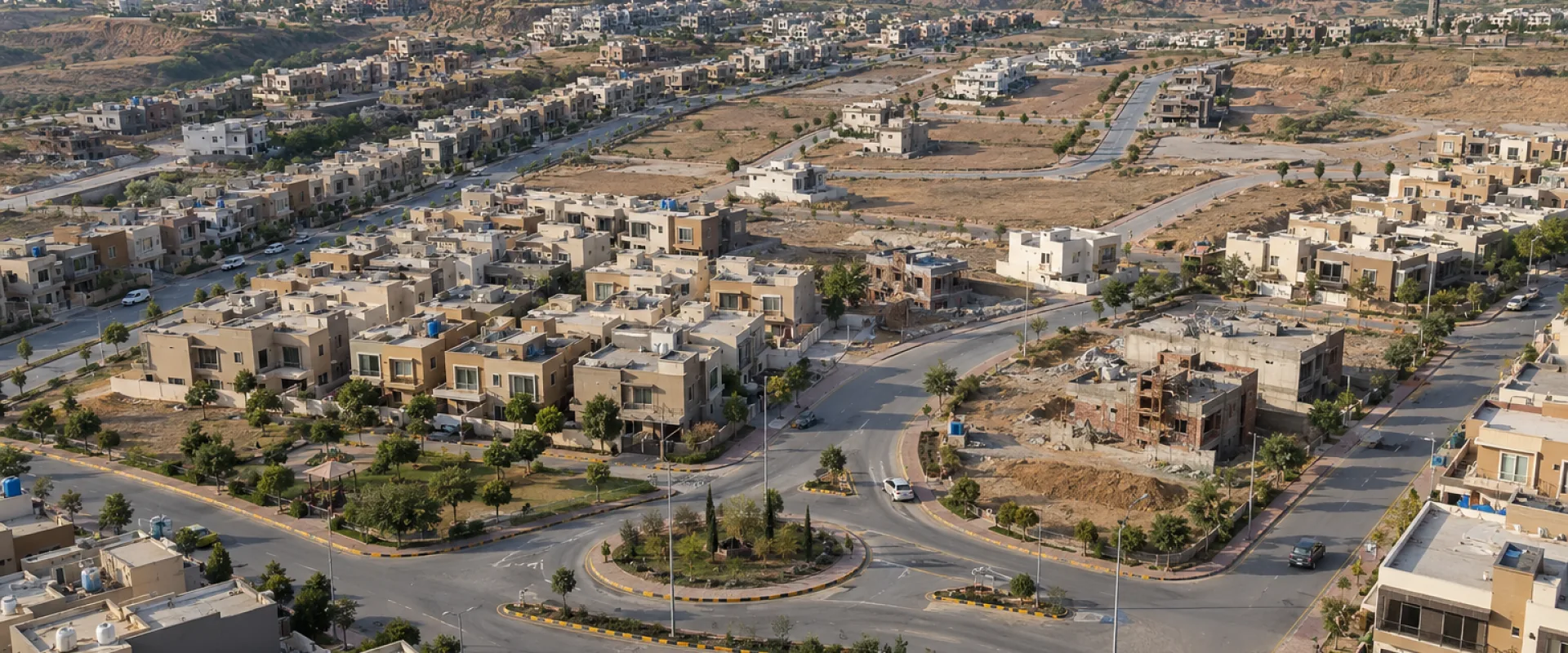
Overseas Pakistanis: Buying Property in Islamabad 2026

If you want to know how overseas Pakistanis can buy property in Islamabad, the short answer is this: pay through your Roshan Digital Account or a normal banking remittance, use your NICOP or POC to claim the filer tax rate as a non-resident, and appoint a trusted person through a NADRA or embassy-attested power of attorney to sign the transfer for you. With proper verification of the plot or house first, you can complete the whole purchase without leaving Dubai, London or Riyadh.
The details matter, though. The tax concession has a verification step most people miss, the transfer process differs between a CDA sector and a private society, and expats are the favourite target of file scams in the twin cities. This guide walks through every step as it stands in November 2026.
Key takeaways
- Non-resident NICOP and POC holders (in Pakistan for less than 183 days in a tax year) can pay advance tax under sections 236K and 236C at the filer rate even if they are not on the Active Taxpayers List (ATL).
- To claim it, the NICOP or POC must be declared and uploaded on the FBR portal when the payment slip (PSID/CPR) is created, and a Commissioner Inland Revenue verifies it before the filer rate applies.
- Roshan Digital Account (RDA) holders can pay for property directly, and can get bank financing under Roshan Apna Ghar. Since June 2026, NICOP and POC holders are also within scope of the subsidised PM Apna Ghar programme.
- NADRA's online power of attorney portal lets you give POA from abroad without a consulate visit; the traditional embassy attestation route still works.
- CDA cut its transfer fee from 3% to 1% of property value in April 2026, which makes CDA sector transfers noticeably cheaper.
- Never pay token money on a file you have not verified with the society or CDA directly, whatever the dealer tells you on WhatsApp.
Payment routes: how overseas Pakistanis can buy property in Islamabad with clean money
How you send the money is not just a convenience question. It decides how easily you can prove the source of funds, repatriate sale proceeds later, and defend the transaction if FBR ever asks. There are three practical routes.
1. Roshan Digital Account (RDA)
The Roshan Digital Account is an SBP-backed account that non-resident Pakistanis (and residents with declared foreign assets) can open online with participating Pakistani banks, without visiting a branch. For property, RDA has three big advantages:
- Direct payment to the seller or developer. You can pay a seller's bank account, a developer or a society from your RDA. Every rupee leaves a clear documentary trail, which matters for roshan digital account property purchases at tax time.
- Repatriation. Funds held in an RDA, and investments made from it, are designed to be repatriable. If you later sell, routing proceeds back through the same channel is cleaner than explaining a cash deal.
- Access to financing. An RDA is the gateway to Roshan Apna Ghar home finance (below).
Keep in mind that the RDA is only the pipe. It does not verify the property for you, and a bank will not stop you from paying a fraudulent "dealer" if you give it the account number.
2. Roshan Apna Ghar and PM Apna Ghar
Roshan Apna Ghar is the SBP initiative, launched in 2021, that lets RDA holders take home finance from participating banks to buy, build or renovate a house in Pakistan, applying from abroad. Some banks also offer financing against a lien on your RDA deposits or Naya Pakistan Certificates. Pricing is set by each bank, so compare offers; we could not find a single published current markup rate.
The bigger news for roshan apna ghar 2026 searches is separate: in June 2026, Profit reported that non-resident NICOP and POC holders were brought into the PM Apna Ghar Programme, the government's subsidised housing finance scheme for first-time buyers. As reported in 2026, the headline terms are financing up to Rs10 million, tenure up to 20 years, a fixed 5% markup for the first ten years, and eligibility limited to houses up to 250 square yards and apartments up to 1,500 square feet. Treat these as reported figures and confirm current terms with your bank or the programme website before applying, because the post-subsidy rate and some eligibility rules have been described differently in different reports.
For apna ghar overseas applicants buying in Islamabad, the size caps are the practical limit. A 5 or 7 marla house, or a one or two bedroom apartment, fits; a 1 kanal house in F-7 does not.
3. Normal remittance to a Pakistani account
Many buyers simply send money through banking channels to their own Pakistani account (a NICOP-linked account, or a family member's account), then pay the seller by pay order. This works, but:
- Remit in your own name to your own account wherever possible. Money sent to a brother's account and paid from there is harder to link to you as the buyer.
- Keep the remittance advice (the PRC or bank's proceeds realisation record) for every transfer.
- Pay the seller by pay order or bank transfer, never cash. Islamabad sub-registrars and societies are increasingly strict about the payment trail.
| Route | Best for | Paper trail | Financing | Watch out for |
|---|---|---|---|---|
| Roshan Digital Account | Most expats, especially larger purchases | Excellent, SBP-documented | Yes (Roshan Apna Ghar) | Bank does not check the property's title |
| Roshan Apna Ghar / PM Apna Ghar | First-time buyers of smaller homes | Excellent | Yes, subsidised for eligible PM Apna Ghar cases | Size caps; bank valuation and title checks take time |
| Bank remittance to own account | Smaller deals, existing accounts | Good if kept in your name | No | Money routed through relatives' accounts |
| Hundi / hawala or cash | Nobody | None | No | Illegal channel, no proof of funds, high fraud risk |
Tax: the filer-rate concession for non-resident NICOP/POC holders
This is where overseas buyers save, or lose, the most money. Under section 111AC of the Income Tax Ordinance and FBR's overseas facility, a Pakistani holding a NICOP or POC who is non-resident (stayed in Pakistan for less than 183 days in the tax year) can pay advance tax on property at the filer rate even if not on the ATL. That is the core of the nicop filer rate property tax concession, and it is explained on FBR's overseas FAQs page.
So the common search "overseas pakistani non filer 236k" has a reassuring answer: if you are genuinely non-resident and hold a NICOP or POC, you should not pay the much higher non-filer rate on purchase. A Pakistani living abroad on a CNIC only, without a NICOP, may not get the concession through this route, so get your NICOP first.
The two taxes at transfer
- Section 236K is paid by the buyer on the fair market value (FBR valuation table value) of the property.
- Section 236C is paid by the seller on the gross amount of the sale.
Rates as checked on 19 November 2026. The Finance Act 2026, effective 1 July 2026, replaced the earlier value-banded filer slabs with flat rates. Published commentary, including advisory firm summaries of the enacted Act, puts the filer rate at 1.25% under 236K and 2.75% under 236C. FBR's own Salient Features document for the budget showed 1.5% for 236K, which appears to reflect the bill as tabled rather than the Act as passed, and FBR's overseas FAQ page still lists the older 2025 slabs. Confirm the rate on the PSID itself before you pay.
| Tax | Who pays | Charged on | Filer rate from 1 July 2026 (reported) | Applies to non-resident NICOP/POC? |
|---|---|---|---|---|
| 236K advance tax | Buyer | FBR fair market value | 1.25% (some FBR material shows 1.5%; confirm) | Yes, filer rate after verification |
| 236C advance tax | Seller | Gross sale amount | 2.75% | Yes, filer rate after verification |
| CDA transfer fee | Usually buyer (negotiable) | Property value | 1% (cut from 3% in April 2026) | Same for everyone |
| Stamp duty and registration (ICT) | Buyer | DC/FBR value | Confirm current rate with the sub-registrar | Same for everyone |
For the full breakdown of transfer costs, see our guide to transfer fees and taxes when buying property in Islamabad.
How to claim the filer rate on the CPR
- The registering authority (CDA, the society, or the sub-registrar's office) creates the payment slip (PSID) through the "Overseas Pakistanis" option on the FBR portal, not the ordinary filer/non-filer option.
- Your NICOP or POC number is entered; NADRA details are fetched automatically. A scanned copy of the card is uploaded and your non-resident status is declared, with supporting documents such as passport entry and exit stamps or your foreign residence permit.
- A provisional PSID is generated and goes to the relevant Commissioner Inland Revenue's IRIS inbox for verification.
- After verification, you are notified by SMS and email, and the tax is paid at the filer rate. The payment receipt (CPR) is what the society or CDA needs to process the transfer.
That Commissioner verification step was added after 30 June 2024, when FBR replaced the old self-declared non-resident category on its portal. Aaj News reported that FBR asked Chief Commissioners to complete verification within one business day, but in practice build in a few days and ask your agent to start the PSID early. If your 183-day status is borderline, or you visited Pakistan for long periods last tax year, take advice before relying on the concession.
Worked example: a 7 marla house in G-13 bought from Dubai
Assume Bilal, a NICOP holder working in Dubai, agrees to buy a 7 marla house in G-13 for Rs 36,000,000, and the FBR valuation for the property is Rs 30,000,000 (illustrative figures; check the actual FBR table for the street).
| Item | Basis | Amount (PKR) |
|---|---|---|
| 236K at filer rate, 1.25% | Rs 30,000,000 FBR value | 375,000 |
| CDA transfer fee, 1% | Rs 30,000,000 (confirm basis with CDA) | 300,000 |
| Same transfer fee before April 2026, 3% | Rs 30,000,000 | 900,000 |
| 236K if 1.5% applied instead | Rs 30,000,000 | 450,000 |
Claiming the filer rate properly saves Bilal a very large sum compared with the non-filer rate, and the April 2026 CDA fee cut alone saves him Rs 600,000 on this example. The seller separately pays 236C of 2.75% on Rs 36,000,000, which is Rs 990,000, so do not let a seller quietly shift that onto you inside the "all-inclusive" price. Stamp duty, registration and agent commission are extra.
Power of attorney property Pakistan overseas: embassy attestation vs NADRA
Most overseas buyers complete the transfer through a power of attorney given to a parent, sibling or trusted lawyer in Islamabad. Choose the attorney carefully: a general POA can let that person sell your property, mortgage it, or receive money on your behalf.
Option A: NADRA online POA
NADRA, with the Ministry of Foreign Affairs, runs an online power of attorney service at poa.nadra.gov.pk. NICOP, CNIC and POC holders abroad can apply online, verify with biometrics (fingerprints through a supported device or app) and give final consent by email, without visiting the embassy or consulate. The attested POA is then available for use in Pakistan. Fees and document requirements vary by country, so check your mission's page for the current schedule.
Option B: Embassy or consulate attestation
The traditional route still works. You sign the POA in person at the Pakistani embassy, high commission or consulate, usually with two witnesses and copies of the NICOP and passport of you and the attorney. The attested POA is then sent to Pakistan, where it may need further registration at the sub-registrar's office before it can be used for a sale or purchase of immovable property in Islamabad.
From the UAE, UK and Saudi Arabia
- UAE: apply through NADRA online, or attend the Pakistan Embassy in Abu Dhabi or the Consulate General in Dubai.
- UK: the Pakistan High Commission in London and the consulates in Manchester, Birmingham, Bradford and Glasgow accept POA work; the High Commission has moved POA processing to the automated system.
- Saudi Arabia: the Embassy in Riyadh and the Consulate General in Jeddah, or the NADRA online route.
A POA signed before a local notary abroad, without Pakistani mission attestation, is generally not accepted for property in Islamabad. Ask for a specific POA naming the exact property (plot number, sector or society, and the action allowed) rather than a general one.
Do you have to come to Pakistan?
Islamabad has moved towards e-registration of property documents (ICT e-registration, developed with NITB), but we could not confirm that an overseas buyer can complete ICT registration fully online without a POA or personal appearance. Punjab's PLRA overseas facilitation and Sindh's overseas services do not apply in the Islamabad Capital Territory. Plan on either a short visit for the transfer or a POA, and ask the sub-registrar or CDA's one-window facility what biometric verification they need at the time of your deal.
Buying in a CDA sector vs a private society from abroad
The choice affects how you verify, how you transfer and how much risk you carry. Our longer guide on CDA sectors vs private societies covers lifestyle and returns; here is the remote-buyer angle.
| Factor | CDA sectors (e.g. F-, G-, E-, I-, D-12) | Private societies (e.g. DHA, Bahria, Gulberg) |
|---|---|---|
| Title record | CDA Estate Management; registered deed via sub-registrar | Society's own transfer records; file or allotment letter |
| Transfer process | CDA transfer, buyer and seller (or attorneys) attend; biometric verification | Society transfer office; many have overseas desks and accept POA |
| Transfer fee | 1% of value since April 2026 | Set by each society; ask for the current schedule |
| Remote verification | Possible through an agent or lawyer at CDA | Many societies verify plot status on request or online |
| Main risk | Fake or duplicate documents, unpaid dues, disputes | Unapproved schemes, unbacked files, layout plan changes |
CDA sectors like F-7, E-11 and G-13 are the safest long-term hold because land title is clear and demand from tenants is steady. Established private societies such as DHA Phase 2 and Bahria Town Phase 7 are popular with expats because their transfer offices are used to POA buyers. For a direct comparison, read DHA Islamabad vs Bahria Town. Whatever you choose, check approval status first: our list of illegal and approved housing societies in Islamabad and Rawalpindi is updated for 2026.
Due-diligence checklist before you buy property from abroad
When you buy property from abroad in Pakistan, you cannot walk the plot, sit in the society office or meet neighbours. Replace that with documents and independent checks.
- Confirm the society or sector is approved by CDA (or RDA for Rawalpindi schemes) and that the specific block or phase has an approved layout plan.
- Verify ownership directly with the authority. For CDA property, get the record checked at CDA Estate Management. For society property, ask the society to confirm the owner's name, plot number and that no transfer is pending. Do not rely on photos of documents sent by the seller.
- Match the seller's CNIC to the title record and, if a seller is using an attorney, verify that POA is genuine and still valid.
- Check dues and charges: development charges, outstanding installments, property tax and utility bills. Since September 2026, CDA/MCI property tax and water bills can be checked and paid on the Pak App, which is a quick way to confirm there are no arrears.
- Check for disputes: a search for pending litigation, mortgages or bank liens on the property.
- Physically inspect through someone independent. A video call walk-through with a person who is not the seller's agent, plus a check that the house matches the approved building plan.
- Write the sale agreement properly: price, token money, payment schedule, who pays which tax and fee, possession date and penalty for default.
- Pay token money only after verification, and only by bank transfer to the title holder's account.
Our step-by-step guide on how to verify a plot or file before you pay token money goes into each document in more detail.
Scams that target expats
Overseas buyers are attractive to fraudsters because they pay quickly, trust relatives and cannot check on the ground. The patterns we see most often in the twin cities:
- Fake or duplicate files. Files sold in "launching soon" projects, or multiple people sold the same file number. Always verify the file with the developer and get it transferred into your name.
- Unapproved societies with glossy marketing. Big launch events in Dubai or Manchester, celebrity ads and "guaranteed returns" for a scheme with no CDA or RDA approval.
- Imposter sellers. Someone poses as the owner with forged CNIC copies, often for an empty plot whose real owner lives abroad too.
- POA misuse by relatives or agents. A general POA used to resell the property or take a loan against it. Give specific POAs and cancel them once the job is done.
- "Pay now to lock the price" pressure. Token money requested within hours, to a personal account that is not the title holder's.
- Construction and rent management fraud. Inflated construction bills or rent collected and not passed on. Use written contracts and bank transfers.
Rule of thumb: if a deal only works when you pay before verifying, it is not a deal.
Renting out and managing from abroad
Many expats buy in Islamabad to rent out until they return. A few practical points:
- Choose rentable locations. Family tenants and embassy staff favour sectors like F-7, F-10 and E-11; see our renting guide to F-7, F-10 and E-11 for what tenants look for.
- Register the tenancy. Islamabad requires tenant information to be registered with the police; use a written tenancy agreement on stamp paper.
- Collect rent by bank transfer into an account in your name, not a caretaker's.
- Pay recurring charges online. CDA/MCI property tax and water bills can now be paid on the Pak App, according to ProPakistani, which removes one common excuse for a caretaker to handle cash.
- Declare rental income. Rent from Pakistani property is Pakistan-source income and is taxable here even if you are non-resident. Your country of residence may also tax it; check the relevant tax treaty.
- Use a property manager with a written mandate covering tenant screening, inspections and repairs, with photos and receipts.
If you plan to build rather than buy ready-made, read our house construction cost guide for Islamabad 2026 before signing a contractor. And when you eventually sell, the capital gains rules, holding periods and 236C rates are covered in our capital gains tax on property 2026-27 guide.
FAQs
Can overseas Pakistanis buy without being a filer?
Yes. A non-resident NICOP or POC holder who stayed in Pakistan for less than 183 days in the tax year can pay 236K and 236C at the filer rate without being on the ATL. The concession must be claimed through the "Overseas Pakistanis" option when the PSID is created, and a Commissioner Inland Revenue verifies it before the filer rate applies.
Can I buy property through my Roshan Digital Account?
Yes. You can pay a seller, developer or society directly from your RDA, and RDA holders can apply for home financing under Roshan Apna Ghar with participating banks. The RDA gives you a clean, repatriable payment trail, but it does not verify the property, so complete due diligence first.
Must I come to Pakistan for the transfer?
Not necessarily. Most overseas buyers complete transfers through an attested power of attorney given to a trusted person in Islamabad. We could not confirm that ICT e-registration currently lets an overseas buyer finish the whole process online without a POA or appearance, so plan on one of the two.
How do I give a power of attorney from the UAE, UK or Saudi Arabia?
Use NADRA's online POA portal (poa.nadra.gov.pk) with biometric verification from abroad, or sign it in person at the Pakistani embassy, high commission or consulate in your country with witnesses. Make it specific to the property, and check whether it must be registered at the sub-registrar in Islamabad before use.
Can a POC holder own property in Islamabad?
Yes. A Pakistan Origin Card holder can own property in Pakistan, including Islamabad, and is covered by the non-resident filer-rate concession. Some societies have their own documentation requirements for POC holders, so confirm with the transfer office before you pay.
What tax does an overseas Pakistani pay on sale?
The seller pays 236C advance tax on the sale amount, reported at 2.75% for filers from 1 July 2026, and non-resident NICOP/POC holders can claim that filer rate. Capital gains tax may also apply depending on when the property was bought and how long it was held; see our capital gains guide and confirm with a tax adviser.
Conclusion
Knowing how overseas Pakistanis can buy property in Islamabad comes down to four things done in the right order: verify the property with CDA or the society, move money through your Roshan Digital Account or your own bank account, claim the non-resident filer rate with your NICOP or POC, and give a specific power of attorney to someone you trust. Get those right and buying from abroad is as safe as buying in person, and with the 2026 cuts to CDA transfer fees and advance tax, cheaper than it was a year ago. For where prices are heading, see our Islamabad property market outlook for 2026.
This article is general information, not legal or tax advice; confirm rates and procedures with FBR, CDA and a qualified lawyer before you transact.
Buying from abroad? Browse verified properties for sale in Islamabad, or contact ISB Real Estate and our team will verify the title, arrange a video inspection and handle the transfer with your attorney.