Land Record Punjab Online Check by CNIC: 2026 Guide
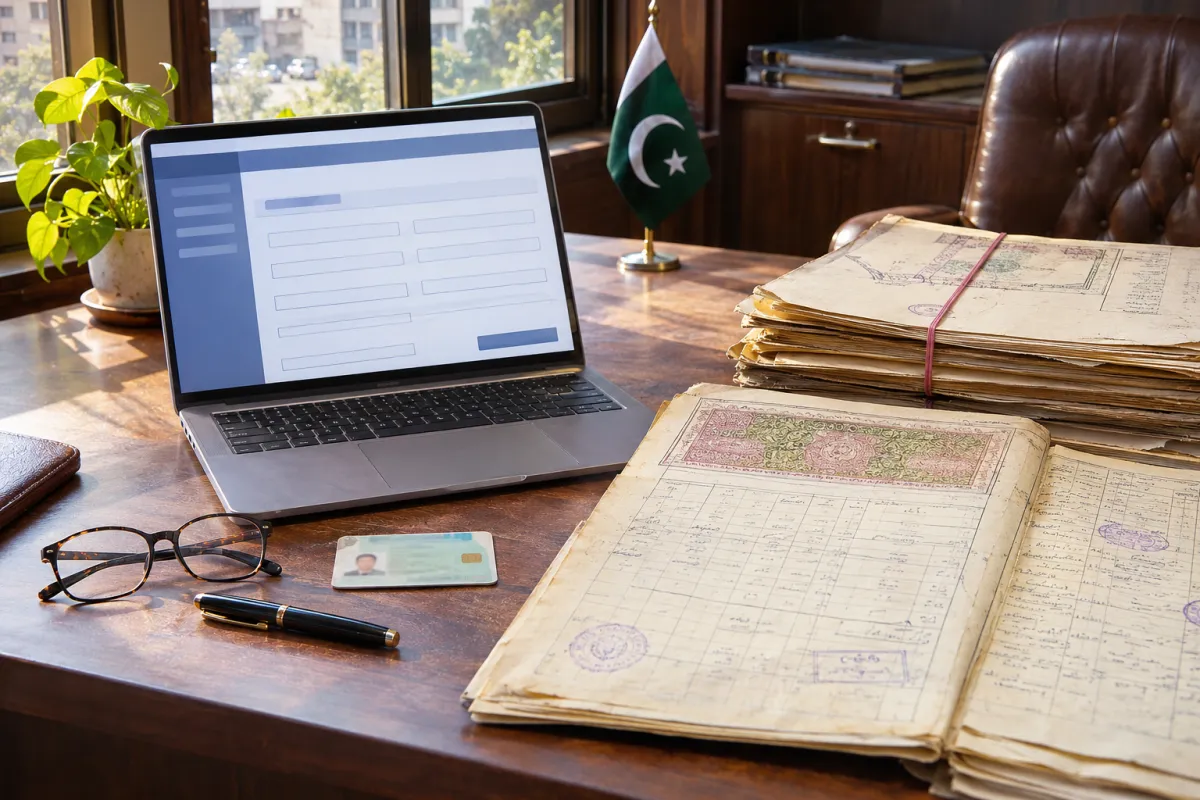
You can do a land record Punjab online check by CNIC in 2026 on the Punjab Land Records Authority (PLRA) portal at punjab-zameen.gov.pk, but the online check only tells you part of the story. The portal lets you search registered deeds by CNIC, name or registration number, and you can request a fard (record of rights) for your own land with a CNIC and a mobile code. For a fard you can use in a sale, you still need to visit an Arazi Record Centre (ARC) for biometric verification. Islamabad works differently: rural land sits with the ICT administration's revenue and patwar system, sector plots sit with CDA's Estate Management, and private society plots sit with each society's transfer office.
This guide is for buyers and families who are about to pay token money on land, a plot or a house in Rawalpindi or Islamabad, and for overseas Pakistanis checking records from abroad. It explains what you can and cannot see online, the current fees, how to read a fard, and the red flags that should stop a deal.
Key takeaways
- Punjab (including Rawalpindi district): PLRA's online search shows registered deeds linked to a CNIC. Online fard is for your own records only. A fard for a sale needs an ARC visit, thumb impression and photo.
- Fees for 2026-27: PLRA's revised schedule, reported in July 2026, puts an ordinary fard at Rs900, an express fard at Rs4,000 and an ordinary mutation at Rs1,200. Government fees set by the Board of Revenue are charged on top.
- Green Property Certificate: Punjab made it mandatory from 1 July 2026, then withdrew the requirement days later. The fard and certified land record copies are again valid for transactions.
- Islamabad: ICT and NITB launched digital fard services in October 2026, but coverage of all revenue estates was still being completed. CDA sector plots and society files are not on the same system.
- An online check is a first filter, not a clearance. Always confirm with the issuing office, and match the fard, the seller's CNIC and the ground before you pay.
Land record Punjab online check by CNIC: what PLRA actually covers
PLRA runs the computerised land record for Punjab's revenue estates (mauzas). That covers agricultural land, rural and peri-urban plots, and many urban properties in the revenue record, including much of Rawalpindi district outside large societies.
According to PLRA officials quoted by the Express Tribune in July 2026, about 96% of Punjab's land records are now digitised. The remaining estates, often older or suburban ones, still need visits to the revenue office.
What PLRA does not cover matters just as much:
- Plots inside DHA, Bahria Town and other large societies are tracked by the society's own transfer system. The revenue record may show the society, not you, as owner of the underlying khasra.
- Files (allocation letters for plots not yet demarcated) are not land records at all. No government portal will show them.
- Islamabad Capital Territory is outside PLRA. It has its own system, covered below.
Punjab land record online check by CNIC: step by step
There are two separate online tools on the PLRA site. One searches registered sale deeds. The other gives you a fard for your own land.
Search registered deeds by CNIC
- Go to punjab-zameen.gov.pk and open the Property Registry Search option on the home page.
- Under the digital registration deed search, choose the district (for example Rawalpindi) and the service centre.
- Choose how to search: CNIC number, bahi number, registration number or name.
- Enter the details, then pick the mauza from the results.
- Click View Details to see the registered deed information.
Get a fard online (personal use)
- On the PLRA home page, open the online fard option.
- Enter your CNIC, NICOP, POC or passport number.
- Enter the code sent to the mobile number registered against your identity.
- Select district, tehsil and mauza.
- State the purpose. The online fard is for personal records only.
Two limits follow from this. First, the online fard is tied to your own CNIC and phone, so as a buyer you cannot pull the seller's fard yourself. Second, a personal-use fard is not the document you transact on. For a sale, the seller gets a fard from an ARC.
Get a fard for a sale at an ARC
- Book a token or appointment and visit the ARC for the tehsil where the land sits.
- Give the owner's name and father's or husband's name. The CNIC can be used to find the khewat instead of remembering the number.
- The owner's thumb impression and photo are taken and matched with NADRA.
- Pay the challan at a Bank of Punjab branch or through e-Pay.
- Collect the printed fard.
Since January 2026, a Fard Baraye Bay (the fard issued for a sale) must carry the buyer's name and CNIC, PLRA announced. The aim is to stop several fards being issued for the same land to different buyers. PLRA also says the fard can be verified on its portal straight away.
e-Mutation and registry
After a sale, ownership moves in the revenue record through a mutation (intiqal), and for most urban property through a registered deed. PLRA lists a separate fee for mutations paid through banks. You still give biometrics at the ARC; the online part is mainly payment and tracking.
PLRA fees for 2026-27
PLRA notified revised service charges with immediate effect for 2026-27. The figures below are as reported by Profit in July 2026.
| Service | PLRA service charge |
|---|---|
| Fard, ordinary | Rs900 |
| Fard, express | Rs4,000 |
| Mutation, ordinary | Rs1,200 |
| Mutation, express | Rs11,200 |
| Mutation through banks | Rs2,100 |
| Registry / e-registration | 0.1% of land value, minimum Rs3,600 |
| Housing society / development authority transfer (Property Transfer System) | Rs3,000 per transaction |
| Green Property Certificate | Rs800 |
These are PLRA's service charges only. Stamp duty, registration fee, CVT and other government levies are set separately by the Board of Revenue, and federal advance taxes under 236C and 236K apply on top. Our guide to capital gains tax and 236C for 2026-27 explains the seller side.
Fard or Green Property Certificate in 2026?
In April 2026 Punjab announced that a Green Property Certificate would replace the fard. Dawn reported a pilot in Sahiwal from 1 May, then Lodhran and Hafizabad from 1 July, with a province-wide switch planned by December 2026.
The rollout hit problems. The certificate became mandatory across Punjab on 1 July 2026, but within days PLRA withdrew the requirement. Daily Pakistan reported that the fard and the certified copy of the land record (naqal arazi record) are again valid for transactions.
For a buyer in Rawalpindi today, that means the fard is still the core document. If the seller already has a Green Property Certificate, it is a useful extra layer, but ask PLRA whether the rules have changed again before you rely on either.
How to read a fard
A fard is an extract from the record of rights (jamabandi) for one holding in one mauza. It looks dense, but a few lines do most of the work.
- Mauza, tehsil and district: check these match the location you were shown. A real plot on Adiala Road and a fard from a different mauza is a serious mismatch.
- Khewat number: the ownership account. All owners sharing that holding are listed under it.
- Khatoni number: the cultivation or occupancy account within the khewat.
- Khasra number(s): the field or survey numbers. This is what ties paper to ground. Ask the patwari or a surveyor to show you the khasra on the map.
- Owner names and share (hissa): in joint holdings, each owner holds a fraction. Work out the seller's share in kanals and marlas and make sure it covers what they are selling you.
- Area: shown in kanal-marla-sarsai. Compare it with the area in the sale agreement.
- Mutation numbers: the history of how the seller got the land. Ask for copies of the key mutations.
- Remarks (kaifiyat): this is where mortgages (rahn), bank charges, stay orders and court references usually appear. Read it every time.
Rule of thumb: if the name on the fard, the name on the seller's CNIC and the person in front of you do not all match, and the khasra on the fard is not the land you walked on, stop. Do not pay token money until all three line up.
Land record Islamabad: how ICT differs from Punjab
Islamabad has three record systems, and which one applies depends on where the property is.
1. ICT revenue estates (rural and zone land)
Land in Islamabad's revenue estates, such as many parts of Zones 2, 4 and 5, is recorded by the ICT administration's revenue department and patwaris. Digitisation has been slow. Reports in mid-2026 said 24 revenue estates were fully digitised, with the rest being completed, and estimates of the total range from 112 to 114 estates.
In October 2026, NITB and the ICT administration launched digital land record services. Citizens can apply for a fard through the Pak App or at Citizen Facilitation Desks, track registry applications and complete transfers with NADRA CNIC verification, biometrics and OTP. Public reporting did not say which estates are covered yet, so ask before assuming your mauza is online.
2. CDA sectors (Estate Management)
Plots and houses in CDA sectors, such as G-13, F-10 or I-8, are not in the patwar record in the same way. Ownership sits with CDA's Estate Management directorates, and transfers happen at CDA's One Window. CDA digitised Sector D-12 as a pilot and has said more sectors will follow. There is no public CNIC search for CDA sector plots. Verification goes through CDA itself, normally with the owner present. For the trade-offs, see CDA sectors vs private societies.
3. Private housing societies
For a plot in a private society, the record that counts is the society's transfer office. Ask the society to confirm the membership number, the current member's name and CNIC, dues and any charges, in writing. Also check that the society itself is approved by CDA in Islamabad, or by RDA in Rawalpindi. Our guide to illegal and approved housing societies explains how to check that.
In 2021 the Islamabad DC office opened a free Property Verification Centre to check the legal status of land and societies within 24 hours. We could not confirm whether it still runs in the same form, so ask at the DC office facilitation centre.
Property verification online by CNIC: what you can and cannot see
People search for property verification online by CNIC hoping for one screen that lists everything a person owns. That does not exist in Pakistan. NADRA verifies identity, but it does not publish property holdings.
What you can see online:
- Registered deeds in Punjab linked to a CNIC, through PLRA's registry search.
- Your own fard in Punjab, and increasingly in Islamabad through the Pak App.
- Public lists of approved and illegal societies from CDA and RDA.
What you cannot see online:
- Someone else's full land holdings by CNIC.
- Society files and membership records.
- CDA sector plot ownership.
- Pending court cases unless they are entered in the fard's remarks.
- Physical possession. Only a site visit shows who is actually on the land.
Red flags in land records
- The seller will only share a photo of the fard, or a fard more than a few days old.
- The seller's name appears as one of many owners in a joint khewat, with no partition.
- The remarks column shows a mortgage, stay order or court case.
- The khasra number on the fard does not match the land you were shown.
- The seller is acting under a power of attorney you cannot verify. See our overseas buyers guide on checking a POA.
- A society plot whose society has no CDA or RDA approval.
Using land records before you pay token money
- Get the basics in writing: seller's CNIC copy, mauza and khasra numbers (or society membership number, or CDA plot number).
- Run the online checks: PLRA registry search for Punjab land, and the society approval lists.
- Ask the seller for a fresh fard issued at the ARC with your name and CNIC on it, and verify it on the PLRA portal.
- Visit the land with the patwari or a surveyor and match the khasra to the ground.
- Confirm with the issuing office: ARC or ICT revenue office for revenue land, CDA Estate Management for sector plots, the society transfer office for society plots.
- Only then pay token money, by bank transfer, against a signed receipt that names the property exactly.
Our full checklist for verifying a plot or file before token money covers the agreement and payment side. For costs at transfer, see transfer fees and taxes in Islamabad.
Frequently asked questions
Can I check land record in Punjab online by CNIC for free?
The PLRA registry search on punjab-zameen.gov.pk does not ask for payment to run a search, though PLRA does not publish a fee policy for it. It shows registered deeds linked to a CNIC in the district and service centre you choose. A printed fard from an ARC costs Rs900 for an ordinary copy under the 2026-27 schedule.
Can I get the seller's fard online with their CNIC?
No. The online fard is sent against the CNIC and mobile number of the owner and is for personal use. Ask the seller to get a Fard Baraye Bay from the ARC with your name and CNIC on it, then verify it on the PLRA portal.
What is PLRA?
PLRA is the Punjab Land Records Authority, under the Punjab Board of Revenue. It runs the computerised land record, Arazi Record Centres, fard issuance and mutations across Punjab, including Rawalpindi district. It does not cover Islamabad.
Is the Green Property Certificate required in 2026?
Not at the time of writing. It became mandatory on 1 July 2026, but PLRA withdrew the requirement within days. The fard and certified land record copies are again valid for transactions. Check with PLRA before you transact, as the policy may change again.
How do I check land record in Islamabad?
For revenue land, use the ICT administration's digital service through the Pak App or a Citizen Facilitation Desk, or visit the revenue office for estates not yet online. For CDA sector plots, verify with CDA Estate Management. For society plots, verify with the society's transfer office and check the society's CDA approval.
Does a clean fard mean the property is safe to buy?
It is a strong start, but not enough on its own. A fard does not prove possession, and it may not show disputes that are not entered in the record. Match the fard to the seller's CNIC and to the ground, and confirm with the issuing office.
Land record checks in 2026: the bottom line
A land record Punjab online check by CNIC is a quick, useful first filter. It will not give you a full picture of a property on its own. In Rawalpindi, get a fresh Fard Baraye Bay with your name on it and verify it. In Islamabad, first work out whether the property is revenue land, a CDA sector plot or a society plot, then go to the right office. Do this before any token money changes hands.
This article is general information, not legal advice. Procedures and fees change. Confirm with PLRA, the ICT administration, CDA or the relevant society before you transact.
Looking at a plot or house in Islamabad or Rawalpindi and want a second pair of eyes on the papers? Contact the ISB Real Estate team and we will help you check the records before you commit.